110KV Angle Steel Transmission Towers: How to Choose a Durable and Cost-Effective Backbone for Your Power Projects
In power infrastructure projects, 110KV transmission lines play a critical “connecting” role in the regional power grid. As the backbone of this power artery, the selection of Angle Steel Towers directly determines the safety and maintenance costs of the line for decades to come. To be honest, many overseas contractors tend to focus solely on the initial price tag during procurement, often overlooking the tower’s real-world performance over its entire lifecycle. Today, let’s talk from a practical, on-the-ground perspective about what truly makes a 110KV angle steel tower excellent.
If your project is located in a coastal area with high salt fog, or a region facing strong winds and heavy ice, corrosion protection and joint stability are absolutely your top priorities. In harsh atmospheric environments, the corrosion rate of traditional carbon steel far exceeds expectations, leading to exorbitant maintenance costs down the road.
It is worth noting that modern, high-quality 110KV angle steel towers are increasingly adopting Weathering Steel technology. By adding trace alloy elements like Cu, Cr, and Ni to the steel matrix, a dense protective rust layer forms on the surface. Field tests have shown that in industrial or marine environments, the corrosion depth of premium weathering steel towers after 50 years can be controlled to around 0.15mm, with an extremely low annual corrosion rate. This means that opting for cold-formed weathering steel towers not only significantly cuts down on initial galvanizing costs but also ensures that the structural strength remains intact for a design life of 40 years or more.
Hardcore Specs: Precision Control from Materials to Joints
For professional engineering buyers, data always speaks louder than adjectives. When designing and manufacturing our 110KV angle steel towers, we strictly adhere to the following core standards:
- Materials & Craftsmanship: Main members and diagonal bracings are typically made from high-strength Q235B or Q355B steel. To meet varying load requirements, we utilize cold-forming processes for the angle steel and perform precise calculations on their geometric properties to ensure axial compressive bearing capacity is fully up to standard.
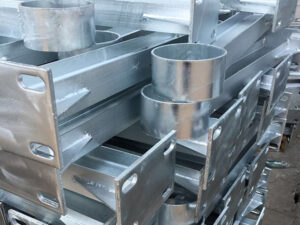
- Corrosion Protection Standards: For standard projects, we use hot-dip galvanization, with zinc coating thickness strictly complying with ASTM A123 or ISO 1461 standards (average thickness usually no less than 86μm). For coastal projects, we highly recommend increasing the zinc coating thickness or opting for the weathering steel solution mentioned earlier.
- Joint Connections: Bolted joints are the “nerve center” of the entire tower. To prevent loosening caused by long-term vibration, we implement multiple anti-loosening measures, such as double nuts and spring washers. The tightening torque for all high-strength bolts is clearly specified (e.g., 80N·m for M16 bolts, 120N·m for M20), ensuring that tensile, compressive, and shear forces are accurately transmitted.
Digital Empowerment: Eliminating On-Site Installation Headaches
Many buyers have encountered this frustrating scenario: the towers arrive at the construction site, only to find that bolt holes don’t align or component dimensions are off, causing severe project delays. To solve this, we integrate digital technology right from the production stage.
Using professional software like Tekla Structures for 3D detailing, we conduct a 100% Trial Assembly test before shipment. Through this “what you see is what you get” digital control, we can identify and eliminate issues like component deformation or misaligned holes in advance. This not only guarantees that the towers can be assembled as smoothly as “building blocks” once they reach the overseas site but also greatly reduces the client’s reliance on highly specialized local installation crews.
Real-World Case Study: Delivery Capability That Stands the Test
Take our recent island grid upgrade project in Southeast Asia as an example. Located in a tropical maritime climate, the area suffers from high humidity and salt levels. The client was initially worried that standard galvanized towers wouldn’t withstand long-term sea breeze corrosion. After several rounds of technical discussions, we provided a customized weathering steel tower solution and optimized the tower’s load design to account for the frequent typhoons in the region. In the end, hundreds of towers were successfully erected before the rainy season hit. The client reported that not only was the installation progress 20% faster than expected, but the towers also remained rock-solid after enduring several severe tropical storms.
Tailored Support for Your Projects
Whether it’s for plains, mountains, or cross-sea engineering, there is no “one-size-fits-all” drawing for 110KV angle steel towers. If you have a power project in the pipeline, feel free to share your specific requirements with us (such as voltage level, number of circuits, local basic wind speed, and ice thickness). We can provide you with free drawing optimization suggestions and a highly competitive engineering quote to help your power infrastructure project land smoothly and securely.