⚡ Transmission Line Towers (Pylons)
Transmission towers are towering structures designed to support high-voltage power lines. Their defining structural feature is the spatial truss design. The framework is primarily composed of single or composite angle steels, typically manufactured from Q235 (A3F) and Q345 (16Mn) grades.
Components are joined using coarse-threaded bolts that rely on shear force for connection. The entire tower consists of angle steels, connecting plates, and bolts. Specific parts, such as the tower base (leg assembly), are often welded from several steel plates into a single unit. This design makes the towers highly conducive to hot-dip galvanizing for corrosion protection, as well as transportation and on-site assembly.
For towers with a height under the cross-arm (call height) of less than 60 meters, climbing pegs (foot bolts) are installed on one of the main structural members to facilitate safe access for maintenance personnel.
📖 Definition
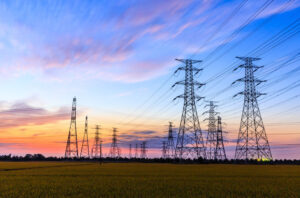
A transmission tower (or pylon) is an elevated structure used to support and suspend overhead conductors (power lines), shield wires (ground wires), and other accessories. Its primary function is to maintain the mandatory safety clearance between conductors, between conductors and the tower, between conductors and shield wires, and between the lines and the ground or any crossed obstacles.
🏗️ Classification
Transmission towers are categorized based on their shape, function, and structural materials.
1. Classification by ShapeCommon shapes include:
- Cup type (often called “Wine Glass” type)
- Cat-head type
- Vertical type (or “I” type)
- Gantries (or “H” / “Portal” type)
- Barrel type
2. Classification by Function
- Suspension/Tangent Tower (Straight-line tower): Used in straight sections of the line to support vertical loads.
- Tension/Strain Tower (Dead-end tower): Used to anchor the line and withstand longitudinal tension.
- Angle/Corner Tower: Located at points where the transmission line changes direction.
- Transposition Tower: Used to physically swap the position of conductors to balance electrical impedance across the three phases.
- Crossing Tower: Taller towers erected on both sides of an obstacle (like a river or highway) to ensure safe clearance.
- Terminal Tower: Located where the transmission line connects to a substation.
3. Classification by Material & Structure
- Materials: The two main types are steel towers and reinforced concrete poles. In China, steel towers are standard for voltages above 110kV, while reinforced concrete poles are commonly used for voltages below 66kV.
- Stability: Towers are classified as self-supporting (freestanding) or guyed (supported by cables). Guy wires help balance lateral loads and conductor tension, reducing the bending moment at the base. This allows for lighter structures and lower costs, making guyed towers common in flat terrain.
Note: The selection of tower type and geometry requires rigorous verification. Engineers must ensure electrical requirements are met while considering voltage levels, circuit numbers, topography, and geological conditions. The final choice is based on a techno-economic comparison to ensure the design is both technically advanced and economically viable.
📐 Tower Structure
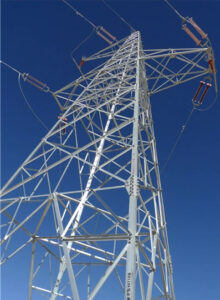
A standard transmission tower is primarily composed of three major sections: the Tower Top, the Tower Body, and the Tower Legs. Guyed towers include an additional cable system.
- Tower Top: This is the section above where the tower’s cross-section changes abruptly (creating a折 line/bend). If there is no abrupt change in the steelwork, the area above the lower chord of the bottom cross-arm is considered the tower top.
- Tower Legs: The lowest section of the steel framework that connects directly to the foundation.
- Tower Body: The middle section of the framework located between the tower legs and the tower top.